

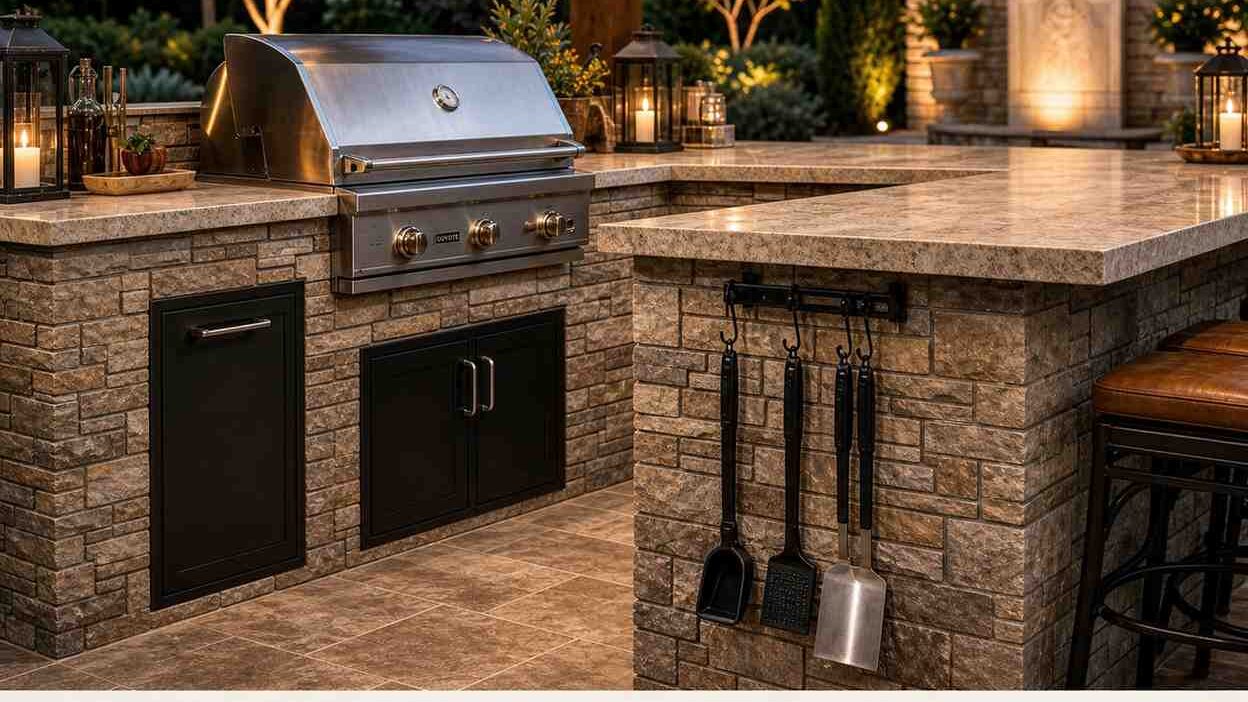
Stone veneer is what turns a plain concrete-block kitchen island into something that looks like it belongs in the yard permanently. The decision that actually matters isn’t which color or texture you like best — it’s natural stone versus manufactured stone, because that one choice drives your budget, your maintenance routine, and how the island holds up through ten winters. Here’s how to make that call, plus everything else worth knowing before a mason shows up.
Key takeaways
- Natural stone veneer costs more ($25–$45/sq ft installed) but handles pressure washing and harsh exposure better; manufactured veneer ($13–$22/sq ft) is lighter, cheaper, and easier to install but more sensitive to pool chemicals.
- A correctly built wall has five layers — structure, moisture barrier, metal lath, scratch coat, and stone — plus a weep screed at the base; skipping any of them is how veneer fails.
- Ledgestone is the most common style for outdoor kitchen islands; fieldstone, ashlar, river rock, and brick-look veneer suit different aesthetics.
- Most outdoor kitchen islands need roughly 40–70 square feet of visible veneer.
- Trapped moisture, not the stone material itself, is the leading cause of outdoor veneer failure.
Stone veneer is a thin layer of stone, either cut from real rock or cast from cement and pigment, applied to the face of a structural wall rather than built as a load-bearing wall itself. On an outdoor kitchen, that structural wall is almost always a CMU block core or a framed structure, with the veneer doing all the visual work on top of it. It’s the standard finish for outdoor kitchen islands because it’s far more weather-tolerant than wood siding, doesn’t need repainting, and reads as substantial and permanent rather than thrown together — which matters more outdoors, where everything is exposed to the elements year-round, than it does on an interior accent wall.
Natural stone veneer vs. manufactured stone veneer: which one should you use outdoors?
This is the one decision to get right before anything else, because it affects structural planning, not just looks. Natural stone veneer is real quarried rock sliced into thin, installable pieces — heavier, pricier, and the gold standard for durability. Manufactured (also called cultured or faux) stone veneer is cast from cement, aggregate, and pigment in molds shaped like real stone — lighter, cheaper, and easier to install, but a bit more particular about where you put it.

| Natural stone veneer | Manufactured stone veneer | |
|---|---|---|
| Weight | 15+ lb/sq ft — often needs a footing or structural ledge | Under 15 lb/sq ft — no extra structural support needed |
| Installed cost | $25–$45 per sq ft | $13–$22 per sq ft |
| Weather resistance | Excellent — handles direct pressure washing | Good, but avoid harsh chemicals and pool-adjacent chlorine exposure |
| Maintenance | Low — rinse it down | Moderate — needs gentler cleaning methods |
| Installation | Best left to an experienced mason | Easier, more forgiving for a confident DIYer |
If your outdoor kitchen sits right next to a pool, lean toward natural stone — chlorine exposure is one of the few things that reliably damages manufactured veneer over time. Everywhere else, manufactured stone veneer holds up perfectly well for most climates and is the more budget-friendly default.
What stone veneer styles work best for outdoor kitchens?
| Style | Look | Best for |
|---|---|---|
| Ledgestone | Flat, horizontally stacked stones with minimal mortar showing | Modern-rustic islands, the most popular choice right now |
| Fieldstone | Rounded, irregular stones in varied sizes | Traditional or cottage-style backyards |
| Ashlar | Cut rectangular stones laid in clean, coursed rows | Formal, symmetrical kitchen designs |
| River rock | Smooth, rounded stones | Casual, lakeside, or coastal-style yards |
| Brick-look veneer | Thin brick profile instead of stone | Classic Americana or colonial-style homes |
For more on pairing a style with the rest of your build, see our [outdoor kitchen pavilion design guide](/outdoor-kitchen-pavilion-design-guide), which covers layout and roofing alongside the island itself.
How is stone veneer actually installed on an outdoor kitchen island?
The finished stone is the last of five layers, and skipping any of the layers underneath it is exactly how veneer fails outdoors. A correctly built wall goes structure, then a weather-resistant moisture barrier, then metal lath, then a scratch coat of mortar, then the stone itself — with a weep screed at the base so any moisture that does get behind the veneer has somewhere to drain back out instead of sitting there.
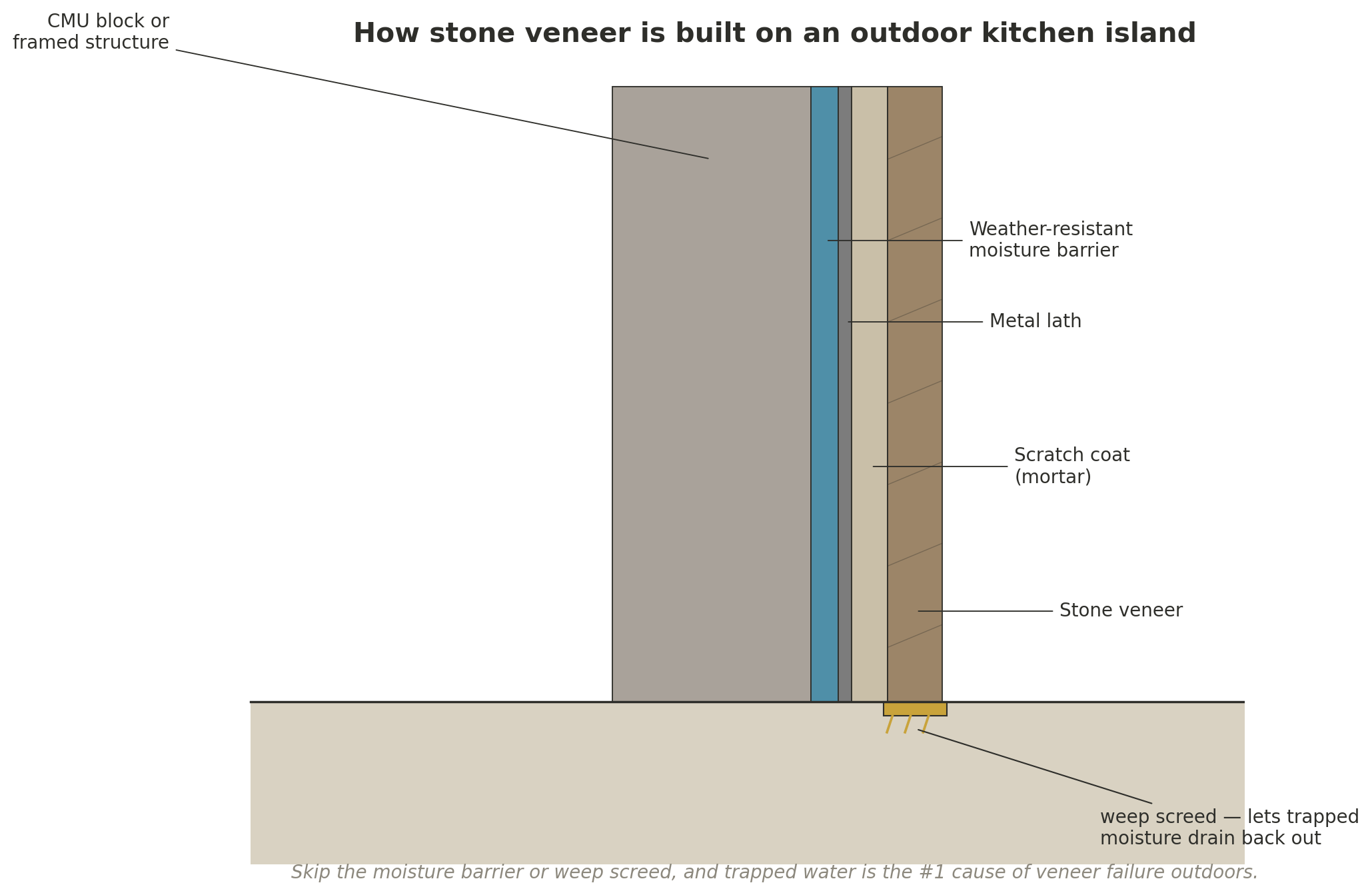
Trapped moisture, not the stone itself, is what actually fails first — water gets behind the veneer, has no way out, and the freeze-thaw cycle through a winter does the rest. Our [outdoor kitchen pavilion design guide](/outdoor-kitchen-pavilion-design-guide) covers the same weep screed and overhang-support details from the structural side, if you’re planning the whole island and not just the finish.
How much does stone veneer cost for an outdoor kitchen?
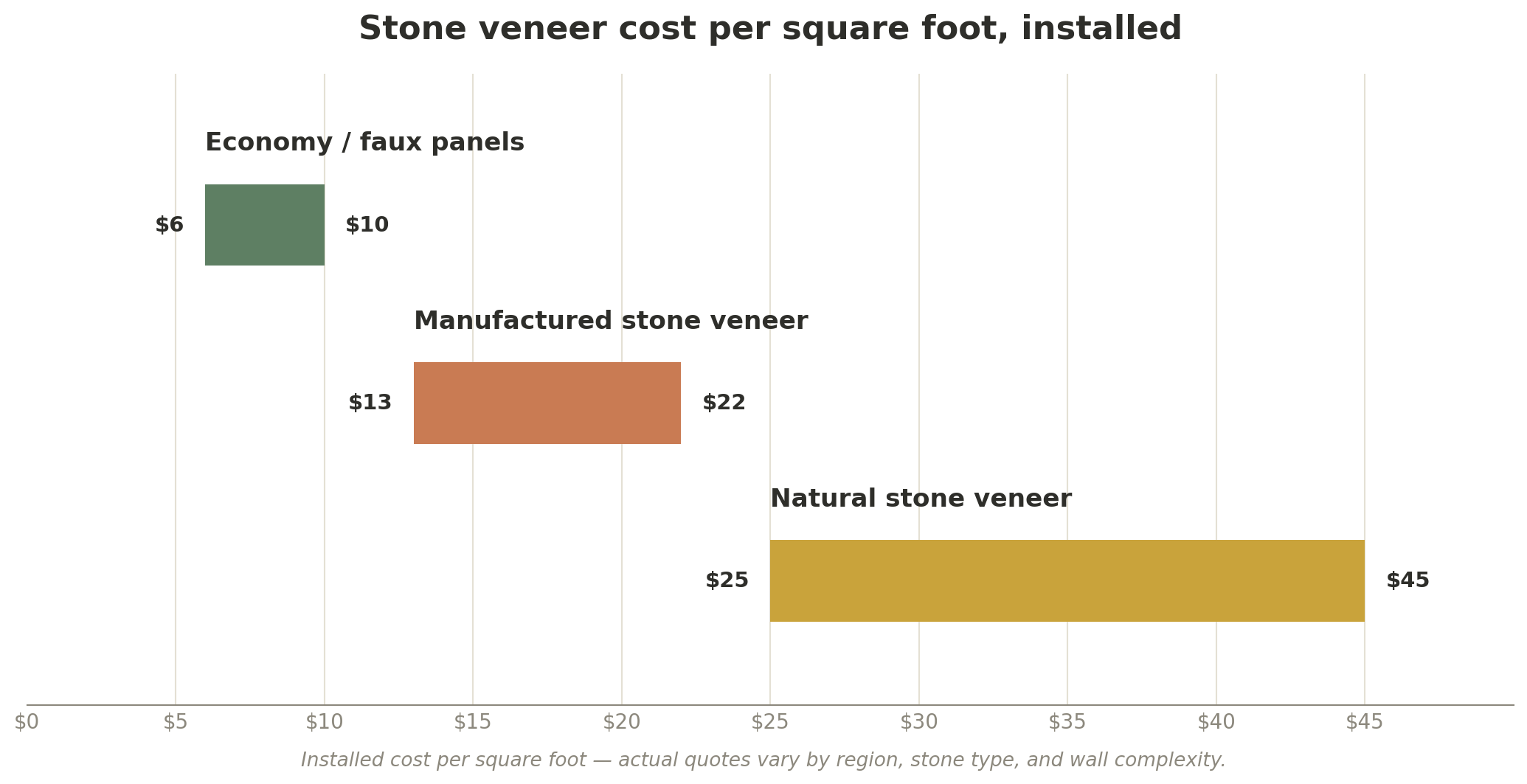
| Tier | Installed cost (per sq ft) | What you’re getting |
|---|---|---|
| Economy / faux panels | $6–$10 | Lightweight mortarless panels, fastest install, least durable |
| Manufactured stone veneer | $13–$22 | The standard choice for most outdoor kitchen islands |
| Natural stone veneer | $25–$45 | Real quarried stone, the most durable and the most expensive |
For a typical outdoor kitchen island — figure roughly 40–70 square feet of visible face — that puts manufactured veneer around $500–$1,500 in material and labor, and natural stone closer to $1,000–$3,000. Get a quote based on your actual island’s dimensions rather than a flat per-project number; veneer pricing scales almost entirely with square footage.
How do you keep stone veneer from failing outdoors?
A few habits go a long way toward making either material last decades instead of years:
- Don’t skip the weep screed. It’s a small, inexpensive detail at install time and the single biggest factor in whether trapped moisture becomes a problem. Match your mortar to your climate. Cold climates with real freeze-thaw cycles need a mortar mix and installation method rated for it — ask your mason specifically, don’t assume the standard mix is fine everywhere.
- Seal natural stone, skip sealing on most manufactured veneer. Many natural stones benefit from a breathable sealer every few years; check with your supplier, since some manufactured products are pre-sealed and don’t need it.
- Keep grills and direct heat sources a few inches off the veneer face, the same way you’d plan clearance for the roof above — heat cycling close to the stone face accelerates wear at the joints.
How do you choose the right stone veneer for your project?
If you’re working with a tight budget and a yard with no pool nearby, manufactured stone veneer in a ledgestone profile is the safest default — it’s the choice most outdoor kitchen islands actually use. If the island sits near a pool, faces harsh winters, or you simply want the most durable, lowest-maintenance option and the budget allows for it, natural stone earns its higher price over a 15–20 year horizon. Either way, get the layer underneath the stone right — that’s the part nobody sees and the part that actually determines how long the finish lasts.
Sources
Material comparisons draw on stone veneer manufacturer and installer guidance on weight, weather resistance, and chemical exposure. Cost ranges reflect 2026 national cost-guide aggregates (per-square-foot installed pricing); always confirm against local quotes, since material and labor costs vary by region and stone type.
Whichever material you land on, plan the finish alongside the structure, not after it — the overhang support, the weep screed, and the veneer all depend on decisions made before the first block goes down. Our outdoor kitchen pavilion design guide walks through the rest of that planning, from layout to grill clearance to cost.
Economy or faux veneer panels run $6–$10 per square foot installed, the lowest cost of the common options, though they trade off some durability and authenticity compared to manufactured or natural stone.